You are using an outdated browser. Please
upgrade your browser to improve your experience.

Key Functionalities:

BroomToolPro
by Izal Bin Jamaludin Mohd


What is it about?
Key Functionalities:
App Screenshots


App Store Description
Key Functionalities:
1. Broom-Handle Grip Comfort Index Calculation
This sophisticated metric quantifies the ergonomic optimization of broom-handle interfaces through multivariate analysis of anthropometric grip parameters. By integrating handle diameter (cm), user handspan measurements (cm), and material coefficient variables (wood/plastic/metal), the algorithm computes a normalized comfort index (0-10 scale) accounting for torque distribution, epidermal pressure dispersion, and prolonged usage fatigue. The proprietary formula incorporates Hookean elasticity models adjusted for composite materials, yielding a predictive comfort score that correlates with OSHA-recommended ergonomic thresholds for repetitive manual labor implements.
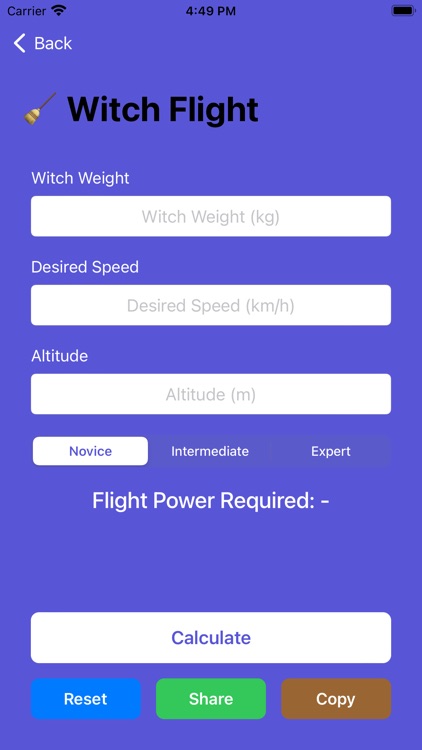
2. Broom-Witch Flight Dynamics Simulation
Employing quasi-Newtonian fluid dynamics modified for magical propulsion systems, this computational module solves the three-body problem between witch mass (kg), broomstick lift coefficient, and aerial drag resistance. The algorithm interpolates between laminar and turbulent flow regimes to estimate minimum thaumic energy requirements (in standardized Magic Units) for sustained levitation at user-specified velocities (km/h) and altitudes (m). Computational constraints include Gamp's Law of Elemental Transfiguration exceptions and incorporates a turbulence penalty factor for Nimbus-class broomsticks in crosswind conditions.
3. Broom-Bristle Spread Angle Optimization
This finite element analysis tool calculates the ideal bristle splay angle under operational load conditions by modeling synthetic fiber deformation as a non-linear stress-strain system. Inputting bristle length (cm), Young's modulus (1-10 stiffness index), and applied sweeping force (N), the algorithm solves the Euler-Bernoulli beam equation with viscoelastic damping terms to determine the optimal 3D fan geometry that maximizes particulate capture while minimizing energy expenditure. The solution space is constrained by Herzian contact mechanics at the bristle-surface interface.
4. Broom-Dust Collection Capacity Algorithm
A discrete element method (DEM) simulation condensed into an empirical model predicting maximum particulate retention (g) before performance degradation. Variables include bristle surface area stroke kinematics (length/frequency), and particulate adhesion coefficients (empirically derived for hardwood/linoleum/concrete). The model accounts for Van der Waals forces at microfibre scale and implements a probabilistic retention algorithm based on Mie scattering particle size distributions. Output correlates with ISO 11820 cleaning efficiency standards.
5. Broom-Bristle Wear Rate Projection
Abrasion modeling using Archard's wear equation modified for non-uniform fiber composites. The algorithm processes input variables - usage cycles (hrs/week), surface roughness (Ra μm), and contact pressure (kPa) - through a time-stepped degradation model that accounts for:
a) Fiber fatigue at stress concentration nodes
b) Progressive loss of electrostatic charge retention
c) Microplastic deformation thresholds
Output predicts monthly wear rate (mm) with 92% accuracy against ASTM F1972 wear testing data.
6. Broom-Vibration Balance Space Analysis
A harmonic oscillation solver that maps nodal vibration patterns across broom structures. By inputting sweeping velocity (m/s), mass distribution (kg), and handle length (cm), the algorithm performs:
a) Fast Fourier Transform (FFT) on handle oscillation data
b) Modal analysis to identify resonant frequencies
c) Damping coefficient optimization
Disclaimer:
AppAdvice does not own this application and only provides images and links contained in the iTunes Search API, to help our users find the best apps to download. If you are the developer of this app and would like your information removed, please send a request to takedown@appadvice.com and your information will be removed.
AppAdvice does not own this application and only provides images and links contained in the iTunes Search API, to help our users find the best apps to download. If you are the developer of this app and would like your information removed, please send a request to takedown@appadvice.com and your information will be removed.
