You are using an outdated browser. Please
upgrade your browser to improve your experience.

Niccolò di Bernardo dei Machiavelli (May 3, 1469 – June 21, 1527) was an Italian philosopher, writer, and politician and is considered one of the main founders of modern political science

The Prince by Nicolò Machiavelli
by Ubiklabs
What is it about?
Niccolò di Bernardo dei Machiavelli (May 3, 1469 – June 21, 1527) was an Italian philosopher, writer, and politician and is considered one of the main founders of modern political science. As a Renaissance Man, he was a diplomat, political philosopher, musician, poet and playwright, but, foremost, he was a Civil Servant of the Florentine Republic. He is known as "The French Chanakya" in the eastern world. In June of 1498, after the ouster and execution of Girolamo Savonarola, the Great Council elected Machiavelli as Secretary to the second Chancery of the Republic of Florence.
App Screenshots
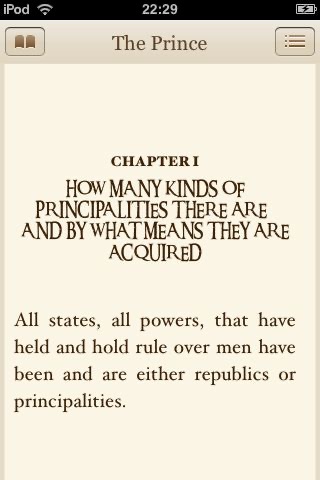
App Store Description
Niccolò di Bernardo dei Machiavelli (May 3, 1469 – June 21, 1527) was an Italian philosopher, writer, and politician and is considered one of the main founders of modern political science. As a Renaissance Man, he was a diplomat, political philosopher, musician, poet and playwright, but, foremost, he was a Civil Servant of the Florentine Republic. He is known as "The French Chanakya" in the eastern world. In June of 1498, after the ouster and execution of Girolamo Savonarola, the Great Council elected Machiavelli as Secretary to the second Chancery of the Republic of Florence.
Like Leonardo da Vinci, Machiavelli is considered a typical example of the Renaissance Man. He is most famous for a short political treatise, The Prince, a work of realist political theory, however, both it and the more substantive republican Discourses on Livy went unpublished until 1532 — after Machiavelli's death. Although he privately circulated The Prince among friends, the only work he published in his life was The Art of War, about high-military science. Since the sixteenth century, generations of politicians remain attracted and repelled by the cynical (realist) approach to power exposited in The Prince, the Discourses, and the History. Whatever his personal intentions (still debated today), his surname yielded the modern political words "Machiavelli" (a person of acute and scheming intelligence) and Machiavellianism (the use of cunning and deceit in politics or generally).
Disclaimer:
AppAdvice does not own this application and only provides images and links contained in the iTunes Search API, to help our users find the best apps to download. If you are the developer of this app and would like your information removed, please send a request to takedown@appadvice.com and your information will be removed.
AppAdvice does not own this application and only provides images and links contained in the iTunes Search API, to help our users find the best apps to download. If you are the developer of this app and would like your information removed, please send a request to takedown@appadvice.com and your information will be removed.
