You are using an outdated browser. Please
upgrade your browser to improve your experience.

The theory of the learning curve or experience curve is based on the simple idea that the time required to perform a task decreases as a worker gains experience

Learning and Experience Curve Calculator - ExpCalc1
by william wright

What is it about?
The theory of the learning curve or experience curve is based on the simple idea that the time required to perform a task decreases as a worker gains experience. The basic concept is that the time, or cost, of performing a task decreases at a constant rate as cumulative output doubles.
App Screenshots
App Store Description
The theory of the learning curve or experience curve is based on the simple idea that the time required to perform a task decreases as a worker gains experience. The basic concept is that the time, or cost, of performing a task decreases at a constant rate as cumulative output doubles.
The application of experience curves has been applied to industry and completive analysis, production benchmarking, capacity planning, forecasting, project management and used in procurement negotiations.
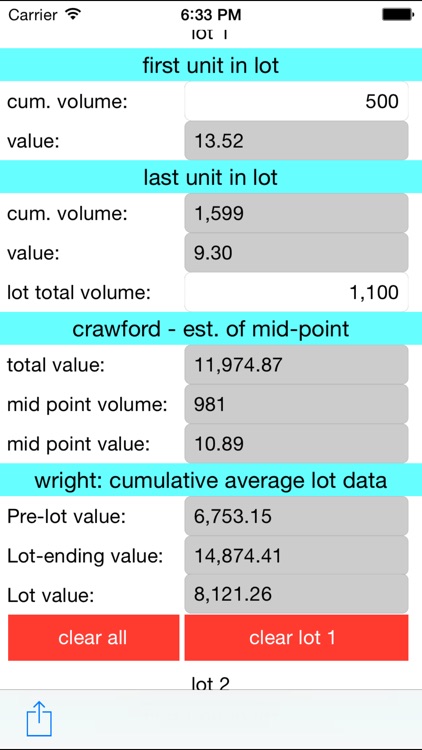
There are two different learning curve models. The original model was developed by T. P. Wright in 1936 and is referred to as the Cumulative Average Model (CAM) or Wright's Model. A team of researchers at Stanford developed a second model; their approach is referred to as the Incremental Unit Time (or Cost) Model (IUM) or Crawford's Model.
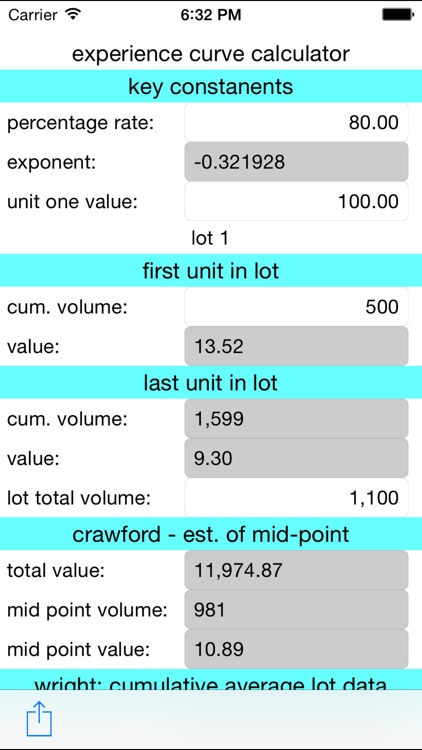
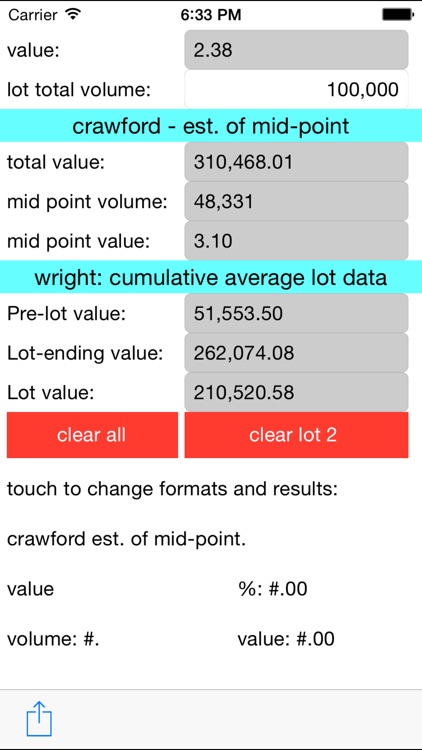
This ExpCalc1 application simplifies the process of working with both CAM and IUM analysis. Using any combination of 27 different input parameters across two lots of data; this calculator evaluates and performs +300 calculations with each input providing key experience curve constants and lot data. Results can be output to Text and comma separated value (CSV) files.
Disclaimer:
AppAdvice does not own this application and only provides images and links contained in the iTunes Search API, to help our users find the best apps to download. If you are the developer of this app and would like your information removed, please send a request to takedown@appadvice.com and your information will be removed.
AppAdvice does not own this application and only provides images and links contained in the iTunes Search API, to help our users find the best apps to download. If you are the developer of this app and would like your information removed, please send a request to takedown@appadvice.com and your information will be removed.
